
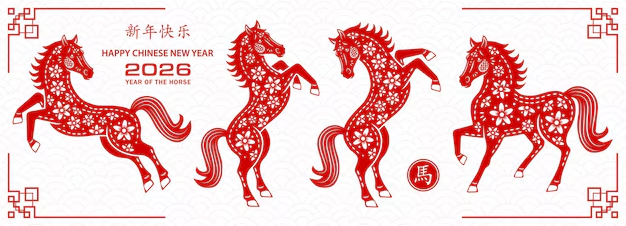
Happy Lunar New Year!
Lunar New Year 2026 starts on Tuesday, February 17th, and ends with the Lantern Festival on March 3rd. The Lunar New Year is also commonly referred to as the Spring Festival or the Chinese New Year. Celebrations last up to 16 days, but only the first 7 days are considered a public holiday (February 17th–February 23rd, 2026).
Lunar New Year traces back around 4,000 years to China’s Shang Dynasty, when it began as an agricultural and spiritual celebration honoring ancestors and deities while welcoming the end of winter. Closely connected to the lunisolar calendar, the holiday includes traditions inspired by the legend of the “Nian” beast, leading to the use of red decorations, fireworks, and loud sounds to ward off evil spirits. Although it takes place during winter, Chinese New Year is widely referred to as the Spring Festival in China. This is because it begins with the “Start of Spring,” the first of the twenty-four solar terms that align with natural seasonal changes, symbolizing the close of winter and the arrival of spring. The Spring Festival marks the start of a new lunar year and reflects hopes for renewal, fresh beginnings, and a better life.
2026 is the Year of the Horse. Chinese New Year signifies the shift from one zodiac sign to the next. The Horse is the 7th animal in the 12-year cycle of the Chinese zodiac signs, coming after the Snake and before the Goat. According to Chinese astrology, those born in the Year of the Horse are confident, sociable, and responsible, yet they value independence. They are energetic and intelligent, thriving on both physical and mental challenges, and while they are decisive, they can also be impatient and easily influenced.
The economic and cultural prosperity of the Tang, Song, and Qing dynasties helped speed the evolution of the Spring Festival, shaping many traditions that closely resemble those practiced today. Activities such as lighting firecrackers, visiting family and friends, and eating dumplings became central to the celebration. At the same time, more festive forms of entertainment emerged, including dragon and lion dances at temple fairs and elaborate lantern displays. Over time, the Spring Festival shifted from primarily a religious observance to a social and celebratory occasion.
In 1912, the government eliminated the Chinese New Year and the lunar calendar, replacing them with the Gregorian calendar and designating January 1 as the official beginning of the New Year. After 1949, the holiday was renamed the Spring Festival and officially recognized as a nationwide public holiday.
